 Online Clock
Financial chaos rarely announces itself with a bang. It doesn't arrive like a sudden market crash or a PR scandal. Instead, it’s a slow, quiet erosion of clarity. It starts with a few missing receipts in June and ends with a panicked, sleepless weekend in January as you stare at a bank balance that doesn’t match your spreadsheets.
For many founders, the realization that they’ve lost control happens during a routine conversation, perhaps a vendor asking about an "overdue" invoice you were certain was paid, or a lender requesting a current P&L that you simply cannot produce. When reports become unreliable and reconciliations fall months behind, you aren't just dealing with an administrative backlog; you are flying your business in a fog. This is precisely why outsourcing bookkeeping services has shifted from a "nice-to-have" cost-saving tactic to a fundamental operational requirement for scaling companies.
This isn't about simple data entry errors. It’s about the operational disorder that sets in when financial visibility vanishes.
Why Do Bookkeeping Problems Become Business Problems?
We often talk about financial errors as if they exist in a vacuum. In reality, your ledger is the heartbeat of your operations. If the data is wrong, every decision downstream is compromised.
Think about your last major hire. Did you base that salary offer on a "gut feeling" about your bank balance, or on a verified three-month trend of net profit? When you set your pricing for a new contract, did you account for the creeping inflation in your overheads, or were you looking at costs from two quarters ago?
The Concept of Bookkeeping Debt
Much like technical debt in software development, Bookkeeping Debt is the price you pay later for taking shortcuts now. Small inaccuracies, a misclassified expense here, a forgotten VAT entry there accumulate quietly. By the time you need to clean it up for an audit, a loan application, or a sale, the "interest" on that debt is paid in expensive forensic accounting fees and immense personal stress.
Signs your business is already carrying this debt include:
- You are constantly three months behind on your records.
- VAT deadlines feel like an emergency rather than a routine task.
- You have a "gut feeling" you're profitable, but the bank balance says otherwise.
- Invoices go out late because nobody is quite sure who has already paid.
- Month-end takes three weeks to close instead of three days.
Mistake #1(Falling Behind on Financial Records)
This is the most common point of failure. It usually begins when a founder or a lean finance team becomes overloaded. You tell yourself you’ll "catch up on Sunday," but Sunday is swallowed by family or more pressing operational fires.
Why the Backlog Happens?
As transaction volume increases, the sheer weight of finance admin grows exponentially. Without a dedicated owner of the bookkeeping workflow, the task is treated as reactive. It becomes something you do when you have to, rather than a proactive habit.
The Hidden Damage
A backlog isn't just "late paperwork." It’s a delay in intelligence. If you don't know your numbers until 45 days after the month ends, you are essentially driving by looking in the rearview mirror. You cannot forecast cash flow if you don't know your current burn rate. You cannot pivot away from a loss-making product if you won't see the loss for another two months.
The Emotional Toll: There is a specific kind of low-grade anxiety that comes from having a "dark" financial corner in your business. It’s the fear of checking your accounts because you aren't sure what you’ll find. Outsourcing bookkeeping services solves this by establishing a dedicated process owner who ensures records are updated in real-time, regardless of how busy the founder gets.
Mistake #2(Poor Reconciliation Practices)
Many business owners look at their bank balance and assume that’s the "truth." This is a dangerous assumption.
The False Reality of Bank Balances
Bank reconciliation is the process of matching your internal records against your bank statements. It sounds simple, but it’s where the most expensive errors hide. Duplicate transactions, missed subscription cancellations, and disconnected payment gateways (like Stripe or PayPal) can create a massive delta between what you think you have and what is actually available.
Why Do Businesses Stop Trusting Their Numbers?
When a business owner spots even one or two significant errors in their reports, they stop trusting the entire data set. Once trust is gone, the reports become useless. You stop looking at them. You go back to "gut feel" management, which is the fastest way to hit a growth ceiling.
By utilizing professional services, you ensure regular reconciliation cycles. A professional bookkeeper doesn't just "input" data; they hunt for discrepancies. They ensure that your payroll matches your bank exit, your VAT matches your sales, and your software integrations are actually talking to each other.
Mistake #3(Mixing Operational Chaos with Financial Management)
Here is a hard truth: a bookkeeper cannot fix a broken business process. If your team is "slack-ing" photos of receipts to a random folder, or if invoice approvals are buried in a manager’s overflowing inbox, your bookkeeping will always be a mess.
Bookkeeping is a Systems Problem
Many companies try to solve financial chaos by throwing more hours at it. They hire a part-time admin to "tidy things up." But without a standardized system, that admin is just reorganizing the chaos.
Growing businesses outgrow DIY systems when:
- Transaction Volume Scales: Moving from 50 to 500 invoices a month requires automation, not just a faster typist.
- Multiple Channels Emerge: Selling on Amazon, Shopify, and via direct invoice requires a complex mapping of sales tax and fees.
- VAT Complexity Increases: Crossing the threshold into different VAT schemes requires precise categorization that an amateur will likely miss.
The value of an outsourced partner isn't just the labor; it's the structure. They bring the software integrations (like Xero, Dext, or Hubdoc) and the workflow accountability that forces your team to be disciplined with documentation.
Mistake #4(Making Decisions Using Inaccurate Financial Data)
This is where bookkeeping errors move from the back office to the boardroom. Strategic damage is the most expensive consequence of poor financial management.
Financial Blind Spots
Consider the "Growth Trap." A business sees revenue climbing 20% month-over-month. They decide to double their marketing spend and hire three new account managers. However, because their bookkeeping is inaccurate, they haven't noticed that their cost of goods sold (COGS) has also risen, or that their "days sales outstanding" (how long it takes customers to pay) has stretched from 30 to 60 days.
They are growing into bankruptcy because their cash flow is deteriorating while their revenue is rising.
Moving from Reactive to Strategic
Bad bookkeeping turns you into a firefighter. You spend your time reacting to "surprises": a surprise tax bill, a surprise cash shortfall, a surprise payroll error. Accurate, timely management reporting allows you to be a navigator instead. When you know your margins are shrinking in real-time, you can adjust your pricing before the quarter is a total loss.
Mistake #5(Choosing Cheap Bookkeeping Instead of Reliable Processes)
In the world of finance, "affordable" is often the most expensive word in the dictionary.
The False Economy of Low-Cost Outsourcing
Many businesses fall into the trap of hiring the cheapest freelancer they can find on a global marketplace. While this saves a few hundred pounds a month initially, the hidden costs are staggering.
- Cleanup Costs: We frequently see businesses pay three times their original fee to a professional firm to "undo" the mess created by an unqualified provider.
- Communication Gaps: When your bookkeeper doesn't understand UK-specific tax nuances or isn't available during your working hours, the friction slows your business down.
- Lack of Accountability: A freelancer might disappear; an established firm has a reputation and a process to maintain.
What Real Visibility Looks Like?
Quality outsourcing bookkeeping services should increase your visibility, not reduce it. You shouldn't feel like your data is disappearing into a black hole. A professional partnership provides you with monthly management packs, proactive updates on KPIs, and a clean audit trail that makes your year-end accounting a breeze rather than a battle.
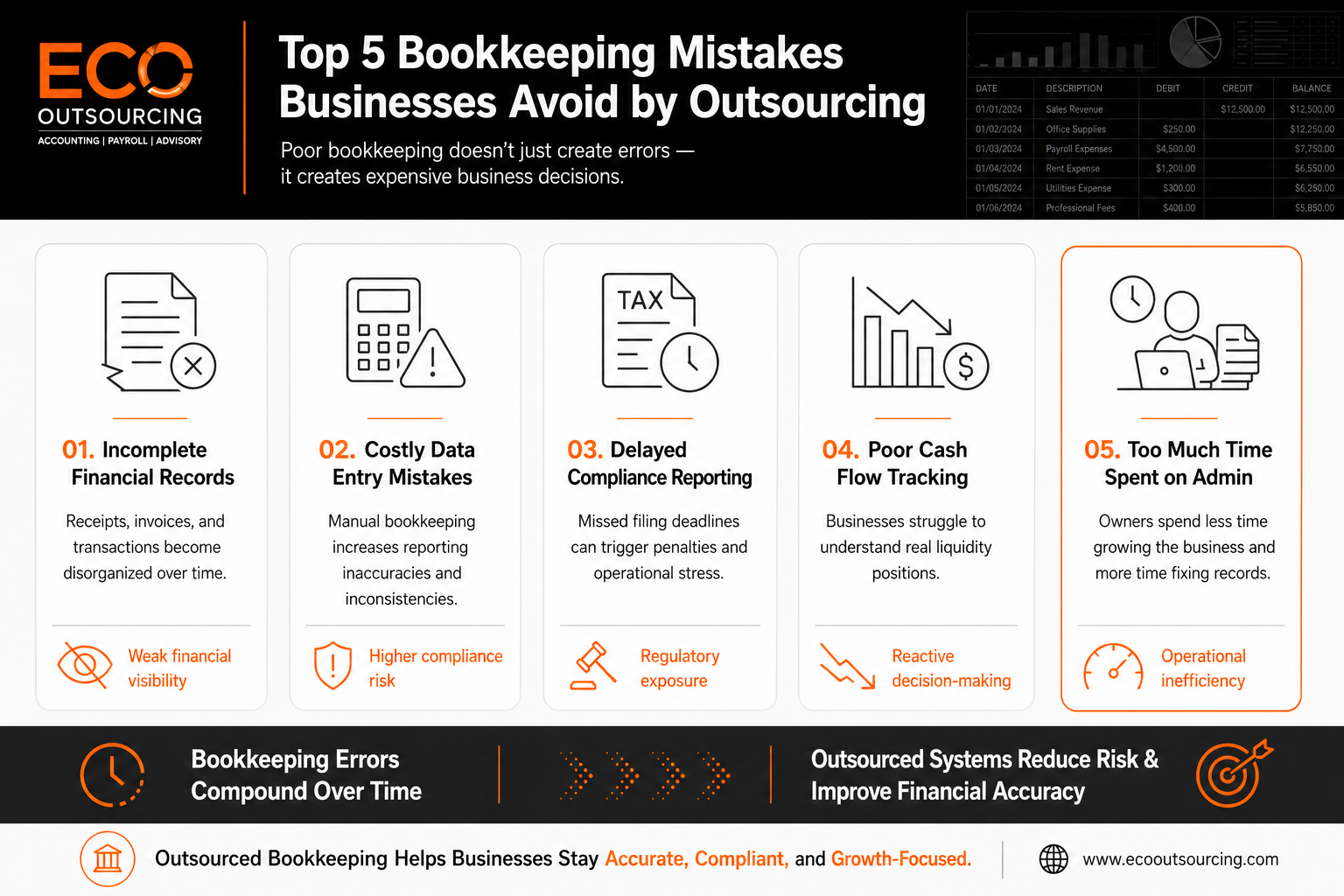
Why Businesses Outsource Before Problems Become Expensive?
Smart founders don't wait for a crisis to fix their finance function. They view bookkeeping as operational infrastructure, not an administrative chore.
In the UK, the pressure is higher than ever. With the rollout of Making Tax Digital (MTD) and increasingly stringent HMRC compliance, the margin for error has vanished. Penalties for late or inaccurate VAT filings are now automated and aggressive. Furthermore, the current shortage of skilled local finance staff makes hiring in-house an expensive, time-consuming risk.
By outsourcing, you buy back your time and, more importantly, your mental bandwidth. You stop being the "Chief Paperwork Officer" and go back to being the CEO.
Signs a Business Has Outgrown DIY Bookkeeping
How do you know it’s time to move on from your current setup? Look for these red flags:
- The Sunday Scaries: You spend your weekends catching up on bank reconciliations.
- Estimation Management: You make hiring or purchasing decisions based on an "estimate" of your cash rather than a report.
- Stressful Deadlines: Tax dates feel like a looming threat rather than a scheduled event.
- Transaction Velocity: You’ve gone from a few dozen transactions to hundreds, and the spreadsheets are breaking.
- Information Lag: You ask for a profit report and are told it will take "a few days" to pull it together.
What Businesses Gain From Financial Clarity?
When you finally have a clean, professional bookkeeping system, the shift in your business is palpable.
- Confidence: You can speak to investors or lenders with total authority because you know your numbers are bulletproof.
- Predictability: Cash flow forecasting becomes a science rather than a guessing game.
- Scalability: You have the systems in place to handle a 2x or 5x increase in volume without the wheels falling off.
- Profitability Tracking: You finally see which products or clients are actually making you money, and which are just keeping you busy.
FAQ(Frequently Asked Questions)
How does outsourcing bookkeeping prevent businesses from mixing personal and business expenses?
Mixing personal and business expenses is one of the most common and costly mistakes small business owners make, often triggering HMRC scrutiny and making year-end accounts a nightmare to untangle. An outsourced bookkeeper establishes clear, structured processes from day one that keep personal and business finances completely separate. They flag any ambiguous transactions immediately and ensure every expense is correctly categorised before it creates a compliance problem. This simple discipline alone saves businesses significant time, money, and stress every single year.
How does outsourcing prevent businesses from falling behind on bank reconciliations?
Many business owners allow bank reconciliations to pile up for weeks or months, creating a growing backlog of unmatched transactions that becomes increasingly difficult to resolve. An outsourced bookkeeper performs reconciliations on a regular, systematic basis ensuring your books always reflect your true financial position in real time. Catching discrepancies early means errors, duplicate payments, and fraudulent transactions are identified before they compound into serious problems. Regular reconciliation also means your financial reports are always accurate and reliable when you need them most.
How does outsourcing help businesses avoid missing VAT deadlines and filing errors?
VAT compliance is one of the most stressful aspects of running a small business, with quarterly deadlines, complex rules, and Making Tax Digital requirements all creating significant pressure. An outsourced bookkeeper manages the entire VAT process categorising transactions, preparing returns, and submitting them well ahead of every deadline. They stay updated on all HMRC rule changes ensuring your VAT filings are always accurate, compliant, and on time. The penalties for late or inaccurate VAT submissions make professional oversight one of the most financially protective investments a business can make.
How does outsourcing prevent the costly mistake of poor cash flow management?
Poor cash flow management is one of the primary reasons small businesses fail despite generating healthy revenue. An outsourced bookkeeper maintains real-time accurate records giving you a clear view of exactly how much cash is available, what is owed to you, and what you owe at any given moment. They monitor outstanding invoices, flag overdue payments, and alert you to upcoming financial commitments before they catch you off guard. This level of visibility transforms cash flow from a constant source of anxiety into a confident, controlled process.
How does outsourcing prevent businesses from losing track of receipts and expense records?
Lost receipts and disorganised expense documentation result in missed tax deductions, inaccurate financial reports, and potential HMRC penalties if records cannot be produced during an enquiry. Outsourced bookkeepers implement digital receipt capture systems like Dext or Hubdoc allowing you to photograph and upload receipts instantly from your phone, eliminating paper entirely. Every expense is digitally recorded, correctly categorised, and securely stored in your cloud accounting system the moment it is captured. This systematic approach ensures you never miss a legitimate tax deduction and always have documentation to support your financial records.
Conclusion:
Bookkeeping mistakes are rarely just about the math; they are symptoms of overwhelmed systems and operational gaps. If you find yourself constantly reacting to financial surprises, your current DIY approach has reached its limit.
The businesses that thrive are those that prioritise financial clarity early, recognising that a clear view of the numbers is the only way to steer through the complexities of growth. That is where Eco Outsourcing comes in. From eliminating receipt chaos and preventing VAT errors to real-time bank reconciliations and accurate monthly management reports, their experienced team tackles every bookkeeping mistake at its root before it costs your business time, money, or credibility.
By partnering with Eco Outsourcing, you aren't just saving time you are building a financial foundation your business can actually scale on